

The key stages of an ERP project
An ERP project generally has 5 stages: review of existing processes, implementation of the solution, change management, cut-over preparation, and finally post-go-live follow-up.
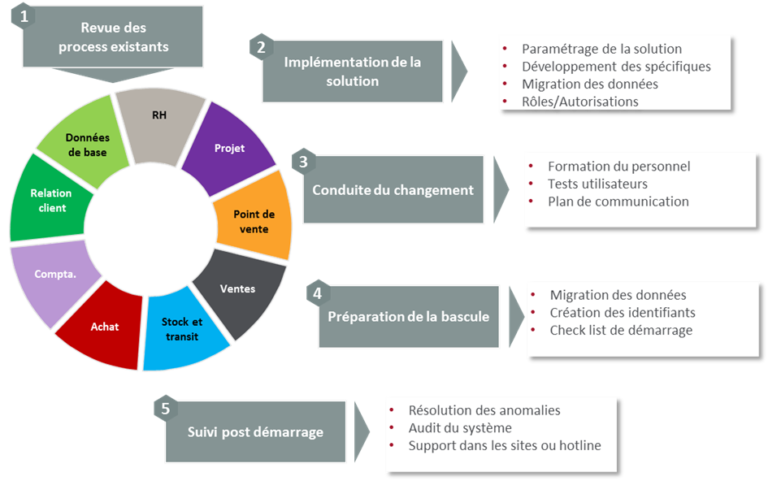
Stage 1: Review of existing processes
This stage consists of diagnosing existing processes, defining target processes and running a fit/gap analysis between the standard ERP and the specific and additional functionality to be built.
Stage 2: Implementing the solution
It has 4 parts: configuration and development, acceptance testing, data migration, and finally management of roles and permissions.
Configuration and development. Configure the solution for the defined scope of needs, develop the specific features, and run unit tests to validate each feature.
Acceptance testing. The main tasks are testing the delivered solution, fixing the anomalies found, and validating the solution with the process leaders.
Data migration. Define the scope of master and transactional data to load into the package, define a data-loading strategy and build the migration objects. It is essential to keep the overall ERP deployment strategy consistent with the data-loading strategy.
Roles and permissions management. The goal is to define the roles and permissions matrix that will be put in place. Roles are then configured and assigned to end users.
Stage 3: Change management
Upstream, a change-management strategy is defined around three themes: communication, training and organisation. During this stage, the organisational impacts of the new tool are explained. Key users are trained by the consultants and then test the configured solution. They must also make sure the company’s employees are trained. Communication materials are produced to prepare the organisational change and the actual launch. This stage can run in parallel with the others, especially for the organisation and communication workstreams.
Stage 4: Cut-over preparation
The goals are to secure go-live and business continuity, validate the organisation of post-go-live support, and validate the quality of the migrated data. This stage can also be used for a full-scale test with end users (simulation).
Stage 5: Post-go-live follow-up
This last stage follows the actual launch of the solution (go-live). It has three specific goals: provide post-go-live support to users, handle and fix the anomalies found in production, and complete the transfer of skills to the teams.
ERP project governance
For a project to succeed, it is crucial to define the roles and responsibilities of each stakeholder and, above all, to have a good project-monitoring structure that makes the project more efficient. Several steering bodies, each with different objectives, are needed.
Example of a governance structure
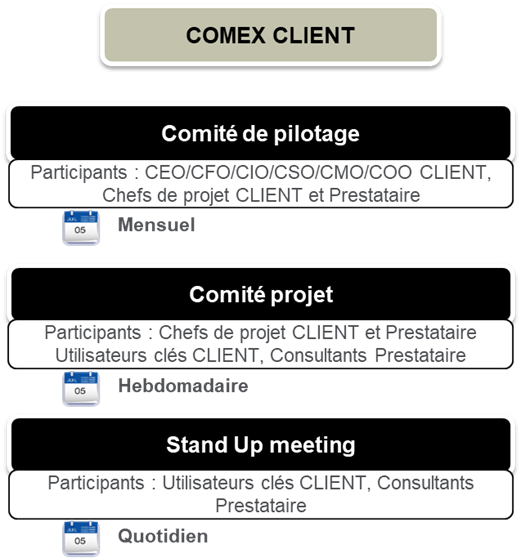
Objectives of project governance
Stand-up meeting (desired frequency: daily; stakeholders: consultants, key users)
- Ensure communication, exchanges and escalation of difficult points
- Escalate to project managers
Project committee (desired frequency: weekly; stakeholders: project managers, consultants, key users)
- Follow progress indicators and the detailed schedule
- Follow up on actions
- Validate end-of-phase deliverables
- Set priorities for each project phase
Steering committee (desired frequency: monthly; stakeholders: executive committee, project managers)
- Validate the strategic choices and direction of the project
- Follow the progress of the main milestones and associated indicators
- Manage the project’s risks, resources and budget
- Make decisions with a major impact on the organisation, methodology, scope and budget of the project